Embark on a journey through the world of forensic accounting services, where financial mysteries are solved and fraud is uncovered with precision and expertise. Discover the crucial role forensic accountants play in safeguarding financial integrity and unraveling complex cases.
Introduction to Forensic Accounting Services
Forensic accounting is a specialized field that combines accounting, auditing, and investigative skills to examine financial records for use in legal proceedings. It plays a vital role in financial investigations by uncovering financial discrepancies, fraud, and misconduct.Forensic accountants are trained to analyze financial data, identify irregularities, and provide expert opinions in court cases. They play a crucial role in detecting and preventing financial fraud by conducting thorough investigations, tracing funds, and reconstructing financial transactions to reveal any fraudulent activities.
Types of Cases where Forensic Accounting Services are Utilized
Forensic accounting services are commonly utilized in cases involving embezzlement, money laundering, insurance claims, bankruptcy, and securities fraud. These professionals also assist in divorce proceedings, business valuation disputes, and other legal matters where financial expertise is required.
Skills and Qualifications Required
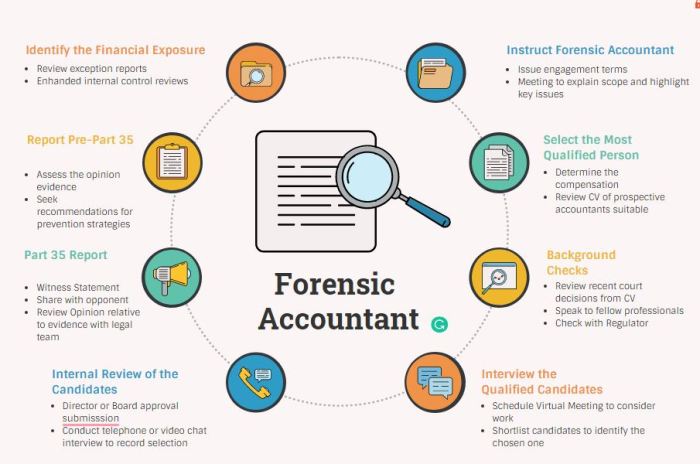
Forensic accounting is a specialized field that requires a unique set of skills and qualifications to excel. Professionals in this field play a critical role in investigating financial discrepancies, analyzing data, and presenting findings in legal settings.
Specific Skills Needed
- Strong Analytical Skills: Forensic accountants must have the ability to analyze complex financial data and identify irregularities or inconsistencies.
- Attention to Detail: Due to the nature of forensic accounting work, meticulous attention to detail is essential to uncovering fraud or financial misconduct.
- Excellent Communication Skills: Forensic accountants need to effectively communicate their findings to stakeholders, including lawyers, clients, and judges.
- Problem-Solving Abilities: Being able to think critically and solve complex financial puzzles is crucial in forensic accounting investigations.
- Knowledge of Accounting Principles and Regulations: A deep understanding of accounting principles and regulations is necessary to navigate financial records and transactions accurately.
Educational Background and Certifications
- Education: Most forensic accountants hold a bachelor’s degree in accounting or finance. Some may pursue advanced degrees such as a Master of Science in Accounting or become a Certified Public Accountant (CPA).
- Certifications: Obtaining certifications such as the Certified Fraud Examiner (CFE) or Certified Forensic Accountant (Cr.FA) can enhance credibility and expertise in the field of forensic accounting.
- Continuing Education: Forensic accountants must stay updated with the latest trends and developments in accounting standards and forensic techniques through continuing education programs.
Importance of Attention to Detail and Analytical Thinking
Forensic accounting work revolves around uncovering financial fraud, embezzlement, and other illicit activities. Attention to detail is crucial in examining financial documents, identifying discrepancies, and following the money trail to uncover fraudulent activities. Analytical thinking helps forensic accountants connect the dots, interpret financial data, and provide valuable insights in legal proceedings.
Tools and Technologies Used
Forensic accountants utilize a variety of software tools and technologies to conduct thorough investigations and analyze financial data effectively.
Software Tools Commonly Used
- Accounting Software (e.g., QuickBooks, Xero)
- Data Analysis Tools (e.g., ACL Analytics, IDEA)
- Forensic Data Analytics Software (e.g., CaseWare IDEA, Tableau)
- E-Discovery Tools (e.g., Relativity, Nuix)
- Financial Modeling Software (e.g., Microsoft Excel, R)
Data Analysis and Visualization Tools
Data analysis and visualization tools play a crucial role in forensic accounting investigations by helping professionals identify patterns, anomalies, and trends within financial data. These tools allow forensic accountants to visualize complex data sets, making it easier to detect fraud, embezzlement, or other financial irregularities. By using tools like Tableau or Power BI, forensic accountants can present their findings in a clear and concise manner, aiding in the communication of complex financial information to stakeholders.
Artificial Intelligence and Machine Learning
Artificial intelligence (AI) and machine learning technologies have revolutionized the field of forensic accounting by enabling professionals to analyze vast amounts of financial data quickly and accurately. These technologies can detect unusual patterns or inconsistencies in financial transactions, helping forensic accountants uncover fraudulent activities more efficiently. AI-powered tools can also automate certain tasks, such as data categorization or anomaly detection, saving time and improving the overall effectiveness of forensic investigations.
Process of Conducting Forensic Accounting
Forensic accounting investigations follow a structured process to uncover financial fraud, misconduct, or discrepancies. This involves gathering evidence, analyzing financial data, and maintaining objectivity and independence throughout the investigation.
Step-by-Step Process of Conducting a Forensic Accounting Investigation
- Identification of the issue or suspicion: The first step involves identifying the specific issue or suspicion that requires investigation, such as fraud, embezzlement, or financial misstatement.
- Collection of evidence: Forensic accountants gather relevant documents, financial records, and other evidence to support their investigation.
- Analysis of financial data: Utilizing various forensic accounting techniques, the financial data is analyzed to detect any irregularities or inconsistencies.
- Interviews and interrogations: Forensic accountants may conduct interviews with employees, stakeholders, or other parties involved to gather additional information.
- Reporting and documentation: A detailed report outlining the findings, analysis, and recommendations is prepared to present the results of the investigation.
Gathering Evidence and Analyzing Financial Data
- Use of data analytics tools: Forensic accountants leverage data analytics tools to examine large volumes of financial data efficiently.
- Tracing financial transactions: By tracing financial transactions, forensic accountants can identify any fraudulent activities or discrepancies.
- Financial statement analysis: Analyzing financial statements helps in detecting any irregularities or manipulation of financial data.
Maintaining Objectivity and Independence
- Adherence to professional standards: Forensic accountants must adhere to professional standards and ethical guidelines to ensure objectivity and independence.
- Avoiding conflicts of interest: It is crucial for forensic accountants to maintain independence and avoid any conflicts of interest that could compromise the investigation.
- Impartial reporting: Forensic accountants must provide impartial and unbiased reporting of their findings to ensure credibility and integrity.
Difference Between Forensic Accounting and Traditional Accounting Services
Forensic accounting and traditional accounting services are both essential in the financial world, but they serve different purposes and have distinct focuses. Let’s explore the key differences between these two types of accounting services.
Focus and Purpose
Forensic accounting is primarily focused on investigating financial discrepancies, fraud, and providing litigation support. On the other hand, traditional accounting services involve tasks like bookkeeping, preparing financial statements, and tax compliance for businesses.
- Forensic accounting aims to uncover financial fraud and misconduct, while traditional accounting focuses on maintaining accurate financial records and ensuring compliance with regulations.
- Forensic accountants often work closely with law enforcement agencies and attorneys to provide expert testimony in court cases, whereas traditional accountants typically work within organizations to manage their financial affairs.
Specialized Nature of Engagements
Forensic accounting engagements are specialized and require unique skills and qualifications compared to traditional accounting services.
Forensic accountants need to have a deep understanding of legal procedures, investigative techniques, and fraud detection methods to effectively uncover financial wrongdoing.
- Traditional accountants are more focused on financial reporting, budgeting, and tax planning, while forensic accountants delve into complex financial transactions and analyze data to detect fraudulent activities.
- Forensic accountants often work on specific cases that require in-depth analysis and meticulous attention to detail, whereas traditional accountants provide ongoing financial support and advisory services to businesses.
Role in Legal Proceedings
Forensic accountants play a crucial role as expert witnesses in legal proceedings, providing their expertise to help resolve financial disputes and investigate fraud allegations. They are often called upon to analyze complex financial data, interpret accounting records, and present their findings in a court of law.
Expert Witness Testimony
Forensic accountants are required to testify as expert witnesses in court cases, where they provide their professional opinion based on their analysis of financial documents. Their testimony helps judges, lawyers, and juries understand the financial aspects of a case, especially when the information is technical or complex.
- Forensic accountants must be objective and impartial when presenting their findings in court.
- They are expected to communicate their analysis clearly and concisely to ensure that the legal professionals and the jury can comprehend the financial information.
- Expert witness testimony from forensic accountants can significantly impact the outcome of a legal case, as their insights can provide crucial evidence to support or refute allegations.
Forensic Accounting Reports as Evidence
Forensic accounting reports prepared by forensic accountants are often used as evidence in court cases to support legal arguments and substantiate claims. These reports contain detailed analyses of financial transactions, patterns, discrepancies, and other relevant information that can help establish the facts of a case.
Forensic accounting reports are considered reliable sources of evidence in legal proceedings due to the expertise and credibility of forensic accountants.
- These reports are submitted as exhibits in court to provide a comprehensive overview of the financial aspects of a case.
- They are used by lawyers to strengthen their arguments, challenge opposing claims, and demonstrate the validity of their client’s positions.
- Forensic accounting reports can help uncover financial fraud, embezzlement, money laundering, and other financial crimes, leading to successful prosecutions.
Presenting Complex Financial Information
Forensic accountants are skilled at presenting complex financial information in a clear and understandable manner to support legal arguments effectively. They use their expertise to simplify intricate financial data and present it in a format that is easily digestible for judges, lawyers, and juries.
- Forensic accountants use visual aids, charts, graphs, and other tools to illustrate their findings and make the information more accessible.
- They break down complex financial concepts into simple terms to ensure that all parties involved in the legal proceedings can grasp the significance of the financial analysis.
- By presenting financial information in a coherent and compelling manner, forensic accountants help legal professionals build stronger cases and make informed decisions based on solid evidence.
Importance of Ethical Standards
Forensic accounting services rely heavily on ethical standards to maintain integrity and trust in the field. Ethical behavior is crucial in ensuring the accuracy and reliability of financial investigations and reports.
Adherence to Professional Codes of Conduct
Forensic accountants are required to follow strict professional codes of conduct and ethical guidelines set by regulatory bodies such as the Association of Certified Fraud Examiners (ACFE) and the American Institute of Certified Public Accountants (AICPA). These guidelines Artikel the expected behavior and ethical responsibilities of forensic accountants in their practice.
- Forensic accountants must maintain objectivity and independence while conducting investigations to ensure unbiased and accurate findings.
- They are obligated to maintain confidentiality to protect sensitive financial information and uphold the privacy rights of individuals involved in the investigation.
- Integrity is paramount in forensic accounting, as professionals must be honest and transparent in their work to preserve the trust of clients, stakeholders, and the public.
Ethical behavior is the foundation of credibility and professionalism in forensic accounting.
Consequences of Ethical Violations
Ethical violations in forensic accounting can have serious repercussions, including damage to reputation, legal consequences, and loss of professional license. Violations such as falsifying evidence, conflicts of interest, or breaching confidentiality can undermine the credibility of the investigation and compromise the integrity of the entire process.
- Forensic accountants found guilty of ethical misconduct may face disciplinary actions, including suspension or revocation of their license to practice.
- Legal repercussions could include fines, lawsuits, or criminal charges if ethical violations lead to illegal activities or financial malpractice.
- The reputation of the forensic accounting firm or individual professional may suffer irreparable harm, leading to loss of clients and business opportunities.
Future Trends in Forensic Accounting
Forensic accounting is a dynamic field that constantly evolves to keep up with the changing landscape of financial crimes and technological advancements. As we look to the future, several emerging trends are shaping the direction of forensic accounting services.
Cybersecurity Investigations
With the rise of cybercrimes and data breaches, cybersecurity investigations are becoming a crucial aspect of forensic accounting. Forensic accountants are now required to analyze digital evidence, identify security breaches, and trace financial transactions in the digital realm to uncover fraudulent activities.
Globalization and Technological Advancements
The increasing interconnectedness of global economies and rapid technological advancements have a significant impact on forensic accounting. As financial transactions become more complex and cross-border, forensic accountants need to adapt their skills and tools to investigate financial crimes on a global scale.
Response to Evolving Financial Crime Trends
As financial criminals become more sophisticated in their methods, forensic accountants must stay ahead of the curve by continuously updating their techniques and knowledge. The future direction of forensic accounting will involve leveraging advanced technologies like artificial intelligence and machine learning to detect and prevent financial fraud more effectively.
Overview of Accounting Services
Accounting services play a crucial role in financial management by providing businesses and individuals with essential financial information to make informed decisions. These services encompass a wide range of activities that help in maintaining accurate financial records, ensuring compliance with regulations, and optimizing financial performance.
Types of Accounting Services
- Bookkeeping: Recording financial transactions, maintaining financial records, and preparing basic financial statements.
- Auditing: Examining financial records to ensure accuracy and compliance with laws and regulations.
- Tax Preparation: Calculating and filing taxes for businesses and individuals to meet legal requirements.
- Financial Reporting: Compiling financial information into reports for internal and external stakeholders.
Role of Accountants in Financial Management
- Accountants help in budgeting by creating financial plans and monitoring performance against budgeted targets.
- They play a crucial role in financial reporting by preparing accurate financial statements that reflect the financial health of an organization.
- Accountants assist businesses and individuals in tax preparation by applying tax laws correctly and maximizing tax deductions.
In conclusion, forensic accounting services stand as a beacon of truth in the realm of finance, ensuring transparency, accountability, and justice. Dive into this fascinating field to witness the intricate work that goes into uncovering financial irregularities and upholding ethical standards.
Question Bank
What is the significance of forensic accounting?
Forensic accounting plays a crucial role in detecting and preventing financial fraud through meticulous investigation and analysis.
What are the specific skills required for forensic accountants?
Forensic accountants need a keen eye for detail, strong analytical skills, and the ability to interpret complex financial data.
How do forensic accountants contribute to legal proceedings?
Forensic accountants act as expert witnesses, present complex financial information clearly, and provide vital evidence in court cases.